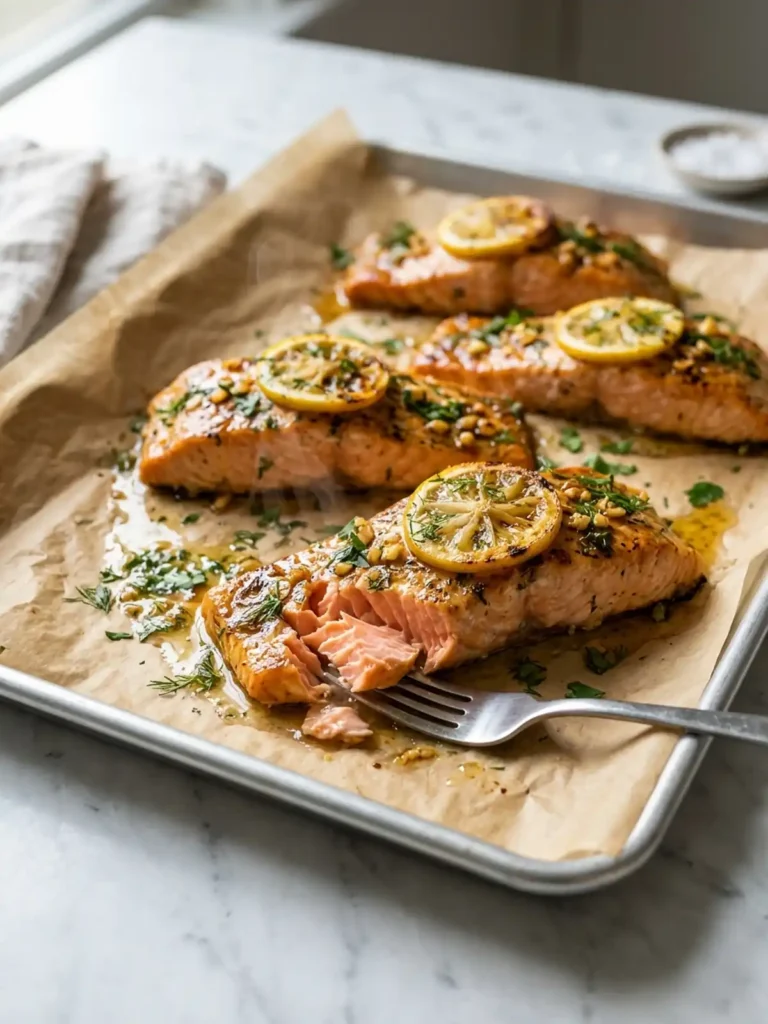
This 20-minute lemon garlic salmon recipe roasts center-cut fillets at 400°F (204°C) under an emulsified glaze of melted butter, extra-virgin olive oil, fresh lemon zest, lemon juice, minced garlic, and a touch of Dijon mustard so the sauce clings to the fish instead of sliding onto the sheet pan. Each flaky, tender 6-ounce fillet delivers 35.4 g of protein and 415 calories with just 5 minutes of prep and one parchment-lined baking sheet to clean.
Table of Contents
Core Ingredients for This Lemon Garlic Salmon Recipe
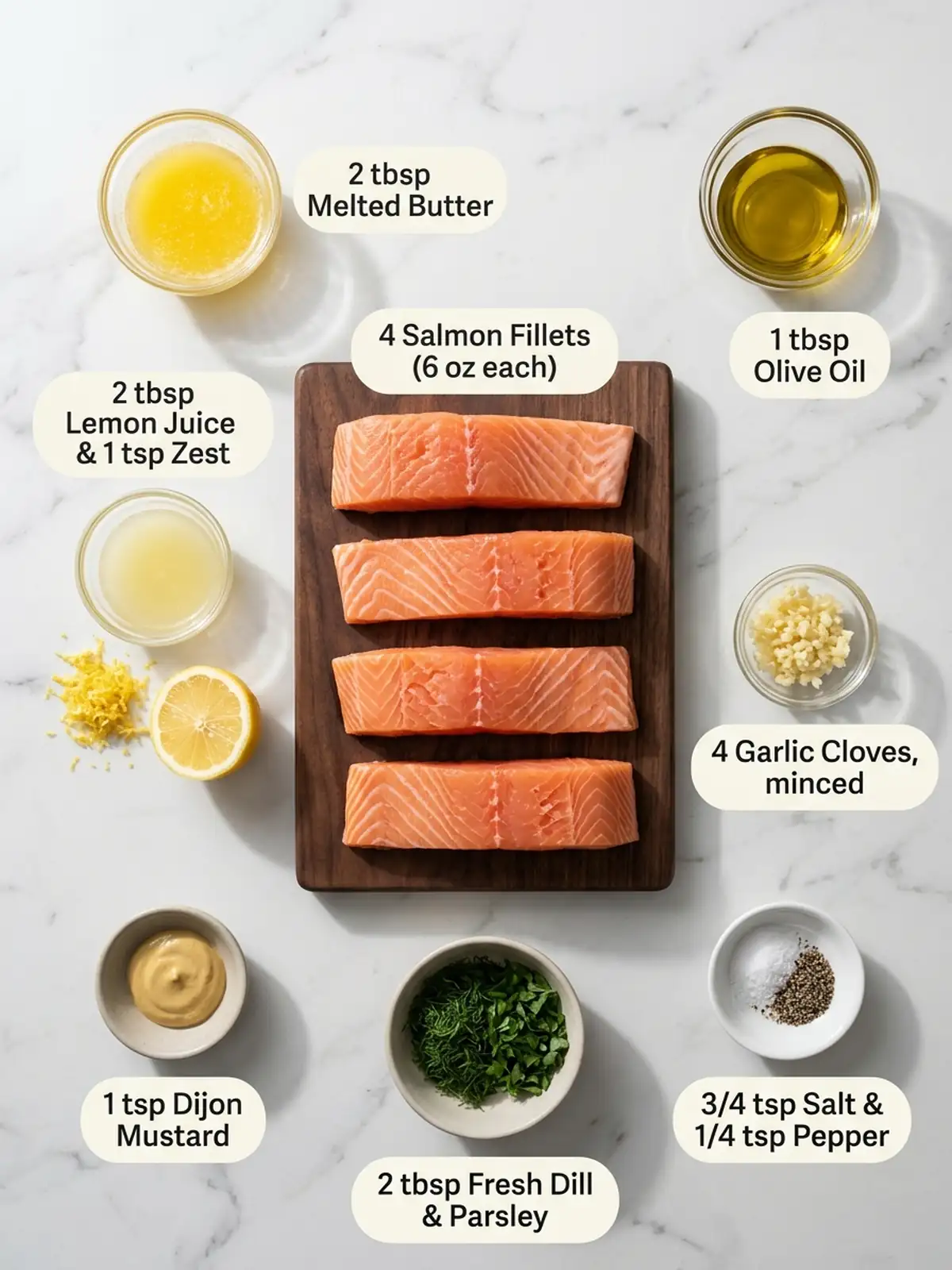
Every ingredient in this lemon garlic butter salmon recipe serves a functional purpose in keeping the fillets moist while building a bright, savory pan sauce:
- Center-cut salmon fillets (4 fillets, 6 oz / 170 g each): Choose center-cut Atlantic, Coho, or King salmon fillets of uniform 1-inch (2.5 cm) thickness so all four pieces reach temperature at the exact same minute. Skin-on fillets insulate the bottom layer against the hot aluminum pan, though skinless fillets work equally well on parchment.
- Unsalted butter (2 tbsp / 28 g, melted) & extra-virgin olive oil (1 tbsp / 15 ml): Combining dairy milk solids from butter with monounsaturated olive oil creates a richer mouthfeel that stays fluid on the platter even as the salmon cools slightly. If you keep homemade roasted garlic herb butter in the fridge, you can melt 3 tablespoons (42 g) directly in place of the plain butter and raw garlic.
- Fresh lemon zest (1 tsp / 2 g) & fresh lemon juice (2 tbsp / 30 ml): Grated yellow lemon zest holds concentrated citrus essential oils (limonene) that survive 400°F (204°C) oven heat without adding excess liquid, while freshly squeezed lemon juice cuts through the natural richness of the salmon fat.
- Fresh garlic cloves (4 cloves / 12 g, finely minced or grated): Microplane-grated or finely minced fresh garlic disperses evenly across the fillets and mellows into sweet, nutty aromatics under the butter glaze.
- Dijon mustard (1 tsp / 5 g): At just one teaspoon, you will not taste a dominant mustard flavor—instead, its natural mucilage emulsifies the melted butter and lemon juice into a cohesive glaze that clings to the top of the fish.
- Kosher salt (3/4 tsp / 2.3 g), black pepper (1/4 tsp / 0.5 g), fresh dill & flat-leaf parsley (2 tbsp / 8 g): Coarse kosher salt seasons the thick fillets evenly, while fresh dill and parsley added after baking preserve their bright, volatile herbal oils.
Culinary Physics: 3 Secrets to Flaky Baked Salmon Without Dry Edges
Most home-baked salmon recipes suffer from two common flaws: watery lemon juice pooling at the bottom of the baking dish while the top dries out, and chalky white protein curds (albumin) oozing from the sides. Three simple adjustments eliminate both problems:
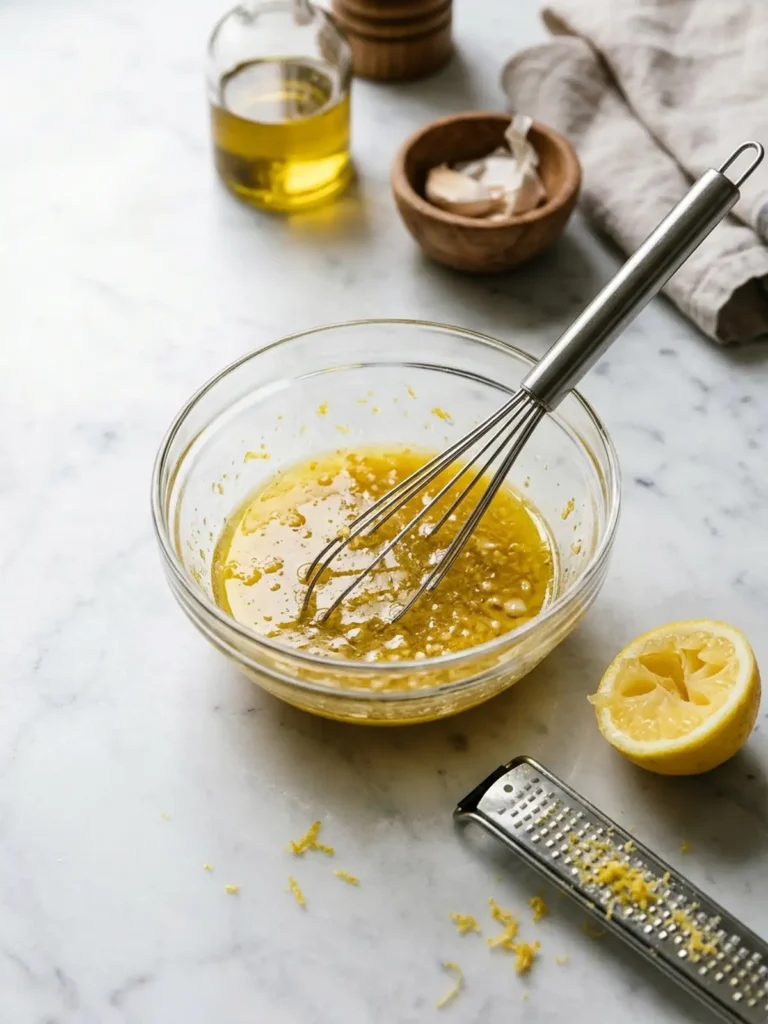
- The Dijon-Lipid Emulsion (Why the Glaze Stays on the Fish): Melted butter (a water-in-oil lipid) and lemon juice (an aqueous acid) naturally repel each other. Whisking 1 teaspoon (5 g) of Dijon mustard into warm melted butter (28 g), olive oil (15 ml), and lemon juice (30 ml) surrounds the microscopic fat droplets so the garlic-citrus mixture forms a thick, velvety coating that bakes directly into the top of the salmon.
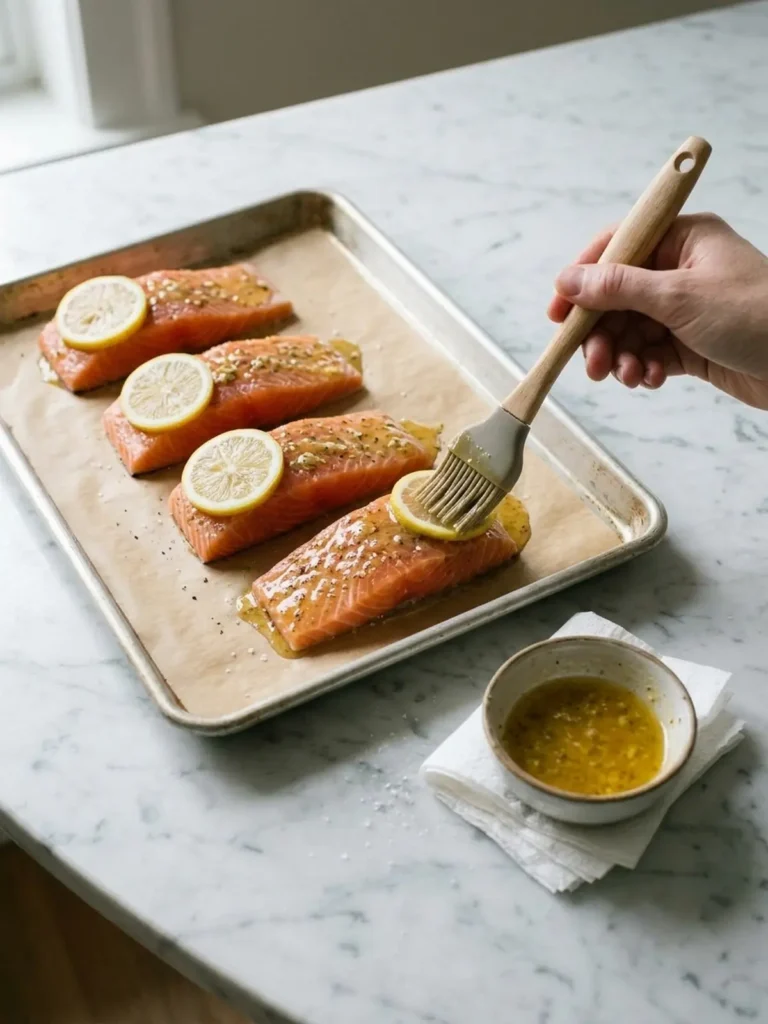
- Zero Pre-Marinating (Preventing Acid Denaturation): Letting raw salmon sit in lemon juice for 20 to 30 minutes before baking chemically denatures the surface myosin proteins—the exact reaction used to make raw ceviche. When that acid-cured outer layer hits a hot oven, it turns tight and chalky before the center warms through. Brushing the lemon-garlic glaze on immediately before sliding the sheet pan into the oven keeps the exterior silky.
- Two-Stage Thermal Roasting vs. Stovetop Searing: If you want a crisp, pan-basted crust cooked entirely on the stove, use our pan-seared garlic butter salmon method in a cast-iron skillet. For hands-off oven cooking, baking uncovered at 400°F (204°C) for 11 to 12 minutes heats the muscle fibers gently enough to minimize white albumin expulsion, while switching to High Broil for the final 2 minutes caramelizes the garlic-butter glaze and blisters the lemon wheels without overcooking the center.
Sheet Pan Spacing, Broiler Timing & Thermal Doneness Cues
Line an 18×13-inch aluminum half-sheet pan with unbleached parchment paper rather than wrapping the fillets tightly in foil if you want golden, lightly caramelized edges. Space the four 6-ounce (170 g) fillets at least 2 inches (5 cm) apart so hot oven air circulates freely around every side instead of steaming the fish in trapped moisture.
Because salmon fillets vary from 3/4 inch (2 cm) on thinner tail pieces to 1.25 inches (3.2 cm) on thick center cuts, judge doneness by both visual cues and an instant-read thermometer inserted horizontally into the thickest center:
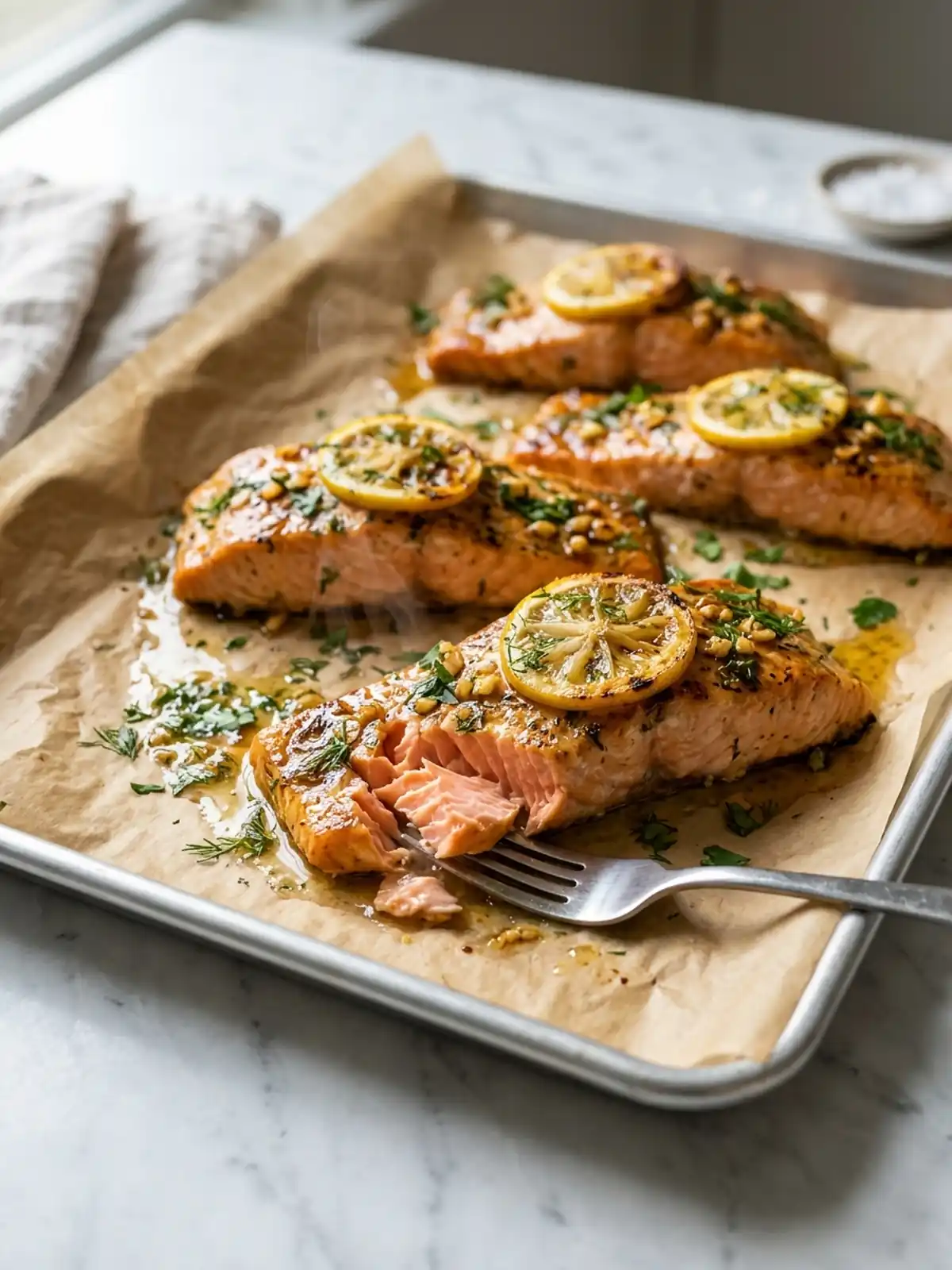
- Visual & Fork-Flake Cue: The sides of the fillet transition from translucent deep orange to opaque coral-pink, tiny golden bubbles form in the garlic-butter glaze, and the flesh separates cleanly along its natural white fat striations when gently pressed with a fork.
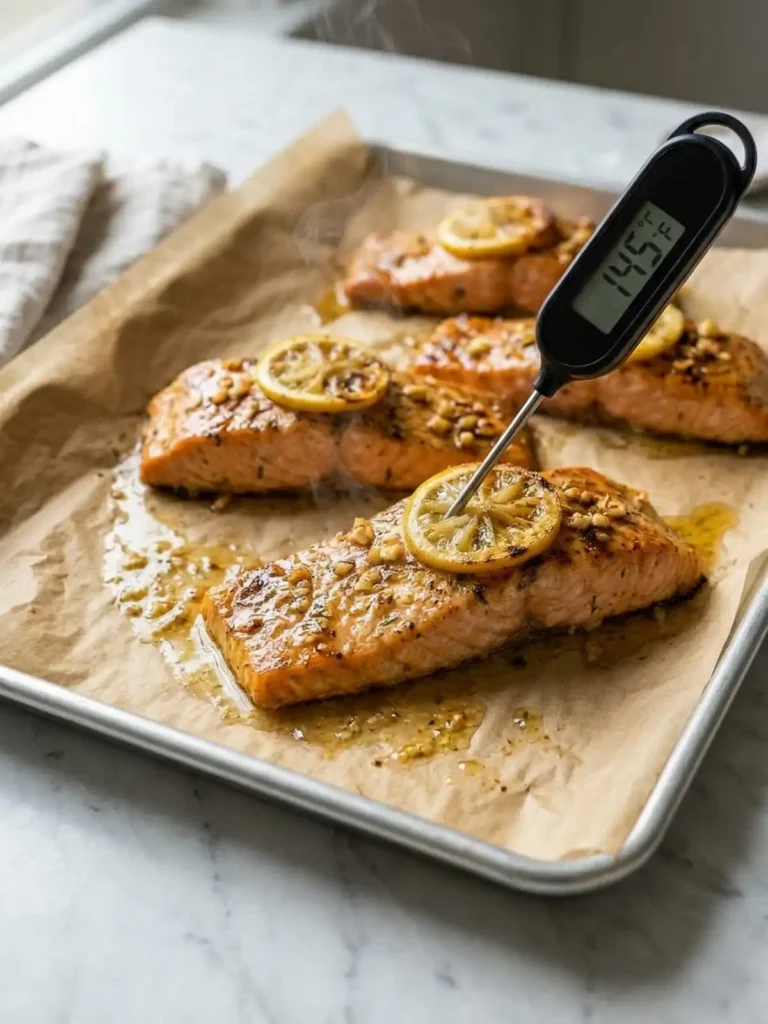
- Food Safety vs. Carry-Over Pull Window: The USDA and FoodSafety.gov safe minimum internal temperature chart specify 145°F (63°C) at the thickest point for all fish and shellfish. Because a hot aluminum sheet pan continues transferring heat for 3 minutes after leaving the oven (carry-over cooking adds roughly 4°F to 5°F), pulling the sheet pan when the center registers 135°F to 140°F (57°C to 60°C) prevents dry, chalky flakes while allowing the resting temperature to climb cleanly.
Air Fryer Conversion, Foil-Packet Option & Smart Swaps
You can adapt this exact emulsified lemon-garlic butter glaze across three kitchen setups or dietary preferences using the reference table below:
| Method or Ingredient Adjustment | Temperature & Ratio | Cook Time (6 oz / 170 g Fillets) | What Changes in Texture |
|---|---|---|---|
| Sheet Pan Oven Bake + Broil (Default) | 400°F (204°C) + High Broil | 11–12 mins bake + 2 mins broil | Tender flaky interior with lightly caramelized garlic-butter edges. |
| Oven-Baked in Foil Packet | 400°F (204°C), sealed foil | 13–15 mins (open foil to broil 2 mins) | Softer, poached-style texture with extra pan broth for spooning over rice. |
| Air Fryer Whole Fillets | 400°F (204°C), perforated parchment | 7–9 mins (no flip needed) | Faster exterior browning; spoon reserved warm lemon butter on top after air frying. |
| Dairy-Free / Whole30 Swap | Replace 2 tbsp (28 g) butter with ghee or extra-virgin olive oil | Same 11–12 mins + 2 mins broil | 100% dairy-free while preserving the Dijon-lemon-garlic emulsion. |
| Fresh Herb Swap | Swap fresh dill/parsley 1:1 with fresh thyme or chives | Add fresh thyme before baking; chives after | Woodier aromatic note with thyme, or mild onion brightness with chives. |
Storage, Gentle Reheating & Weekly Meal Prep
Transfer cooled leftover salmon fillets and their solidified lemon-garlic pan juices into an airtight glass container and refrigerate within 2 hours of cooking for up to 3 to 4 days, or freeze wrapped tightly in parchment and freezer bags for up to 3 months. To reheat without drying out the delicate proteins, place the salmon in a covered skillet over low heat with 1 tablespoon (15 ml) of water or broth for 4 to 5 minutes, or warm covered in a 275°F (135°C) oven for 10 to 12 minutes until heated through.
Calculated from USDA FoodData Central reference values, each 6-ounce (170 g) glazed fillet provides 415 kcal, 35.4 g complete protein, 29.2 g fat (including heart-healthy omega-3 fatty acids), and just 2.1 g carbohydrates. Flake cold or gently warmed leftovers over grain bowls alongside our crispy air fryer salmon bites bowl components (jasmine rice, cucumber, and edamame), or pair this oven method with crispy honey garlic salmon bites when prepping two flavors of salmon for the week.
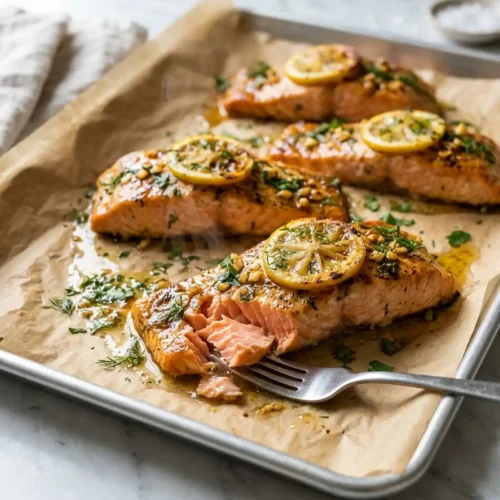
Baked Lemon Garlic Salmon Recipe

Equipment
- Rimmed aluminum half-sheet pan (18×13-inch)
- Unbleached parchment paper
- Small glass mixing bowl and balloon whisk
- Microplane zester and citrus juicer
- Silicone basting brush or spoon
- Instant-read digital thermometer
Ingredients
- 4 center-cut salmon fillets about 6 oz / 170 g each, skin-on or skinless, patted dry
- 2 tbsp unsalted butter 28 g, melted and slightly cooled
- 1 tbsp extra-virgin olive oil 15 ml
- 2 tbsp fresh lemon juice 30 ml, freshly squeezed from 1 medium lemon
- 1 tsp finely grated lemon zest 2 g, yellow zest only, plus 4 thin lemon slices for topping
- 4 garlic cloves 12 g, finely minced or grated
- 1 tsp Dijon mustard 5 g, emulsifies the lemon-butter glaze
- 3/4 tsp kosher salt 2.3 g
- 1/4 tsp freshly ground black pepper 0.5 g
- 2 tbsp fresh dill and flat-leaf parsley 8 g, finely chopped, for garnish
Instructions
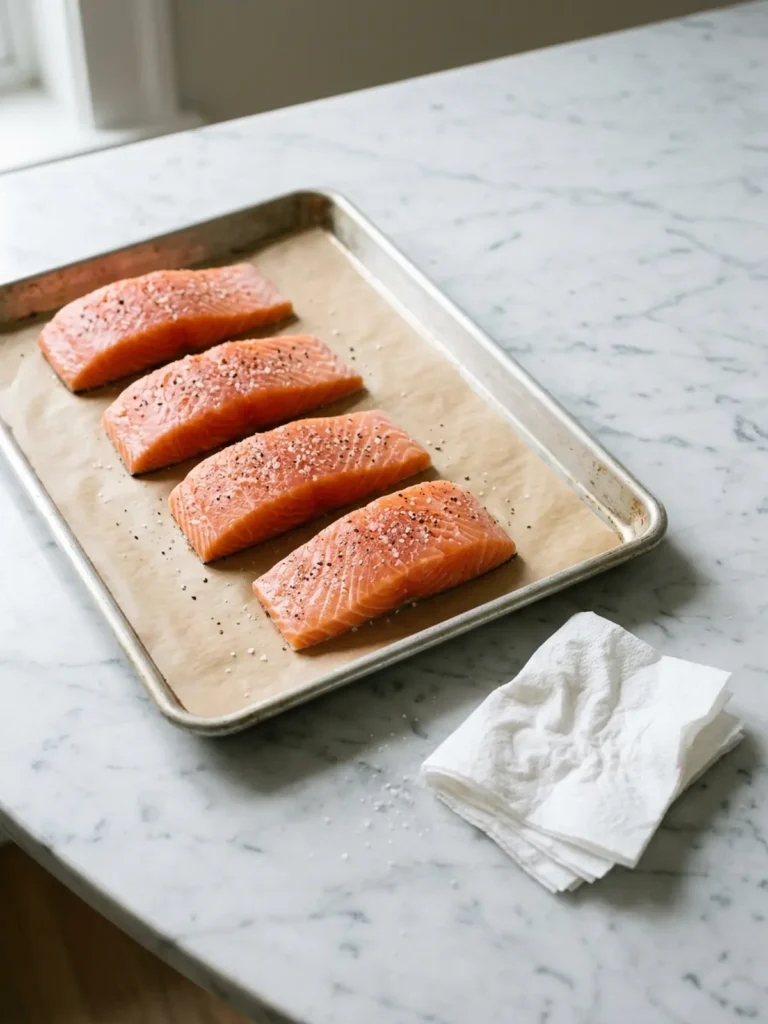
- Position an oven rack in the center (about 6 inches below the top broiler element) and preheat the oven to 400°F (204°C). Line a rimmed aluminum half-sheet pan with unbleached parchment paper. Pat the 4 salmon fillets (6 oz / 170 g each) thoroughly dry with paper towels, arrange them skin-side down with at least 2 inches (5 cm) of space between fillets, and season evenly with the kosher salt (3/4 tsp / 2.3 g) and black pepper (1/4 tsp / 0.5 g).
- In a small glass bowl, whisk together the melted unsalted butter (2 tbsp / 28 g), extra-virgin olive oil (1 tbsp / 15 ml), fresh lemon juice (2 tbsp / 30 ml), finely grated lemon zest (1 tsp / 2 g), minced garlic (4 cloves / 12 g), and Dijon mustard (1 tsp / 5 g) for 20 seconds until the mixture forms a glossy, unified emulsion that will cling to the fish without separating.
- Spoon or brush the emulsified lemon-garlic butter evenly over the top and sides of each salmon fillet right before baking (do not marinate ahead, or the lemon acid will chalk the surface proteins). Place 1 thin fresh lemon slice on the corner of each fillet.
- Bake uncovered at 400°F (204°C) for 11 to 12 minutes until the sides are opaque coral-pink, then switch the oven to High Broil for 2 to 3 minutes until the garlic-butter glaze bubbles and the edges lightly caramelize. Verify the thickest center reaches 145°F (63°C) on an instant-read thermometer (or pull at 135°F / 57°C for medium-flaky texture and let carry-over heat finish).
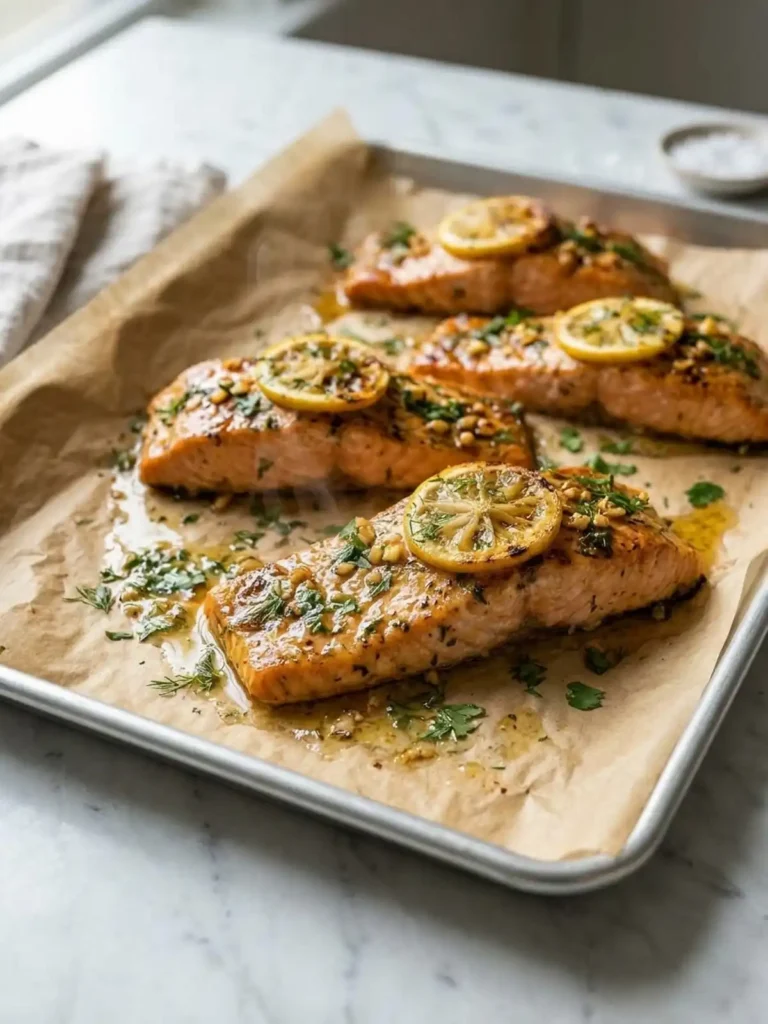
- Remove the sheet pan from the oven and let the salmon rest for 3 minutes so the warm muscle fibers reabsorb their juices. Spoon the melted lemon-garlic pan juices from the parchment over the fillets, scatter with chopped fresh dill and flat-leaf parsley (2 tbsp / 8 g), and serve warm.
Notes
Nutrition
Frequently Asked Questions
How long do you bake lemon garlic salmon at 400°F?
For standard 1-inch-thick (2.5 cm), 6-ounce (170 g) center-cut fillets, bake uncovered at 400°F (204°C) for 11 to 12 minutes, followed by 2 minutes under the broiler so the garlic butter caramelizes as the center reaches 145°F (63°C). Thinner wild sockeye fillets (1/2 to 3/4 inch thick) need only 8 to 10 minutes total.
Should I bake lemon garlic butter salmon covered in foil or uncovered?
Baking uncovered on a parchment-lined half-sheet pan allows excess surface moisture to evaporate so the emulsified lemon-garlic butter glaze browns lightly around the edges. If you prefer a softer, steamed texture with more liquid sauce, tent aluminum foil loosely over the fillets for the first 12 minutes, then fold the foil back for the final 2-minute broil.
How do I stop the white stuff (albumin) from coming out of baked salmon?
That white substance is albumin, a liquid muscle protein that squeezes out and coagulates when salmon is exposed to excessive heat or overcooked past 145°F (63°C). Patting the fillets dry, glazing them with fat (butter and olive oil) to buffer surface heat, and pulling the pan on time keeps albumin to an absolute minimum.
Can I use frozen salmon fillets for this recipe?
Yes—thaw frozen salmon overnight in the refrigerator (removing it from any vacuum-sealed plastic packaging first), then press firmly with paper towels to remove all purge water before seasoning and glazing so the butter emulsion adheres properly.